
The stale candy bar and lukewarm soda machine that's sat in the corner since 2015 isn't cutting it anymore. Employees want fresh food. Facility managers want equipment that doesn't break down every other week. And businesses want break rooms that actually make people want to stay at the office instead of driving to Chick-fil-A.
The shift is measurable, too. 48% of workers say the availability of free food at work influences whether they'd accept a new job, according to NAMA Foundation research. That's not a minor perk anymore. It's a hiring tool.
This guide breaks down the top vending machine alternatives, how to pick the right one for your space, and answers the questions business owners ask most about vending in 2026.
Key Takeaways
- Micro-markets, smart coolers, and coffee/pantry services outperform traditional vending on variety, freshness, and all-day access
- Match the format to your space, headcount, and goal—wellness, retention, or pure convenience
- Traditional vending still fits high-traffic or tight spaces in 2026, but multi-format setups usually serve employees better
- Full-service providers like CDS Refresh combine micro-markets, coffee, pantry, and smart coolers instead of forcing one machine to do it all
Why Businesses Are Looking Beyond Traditional Vending Machines
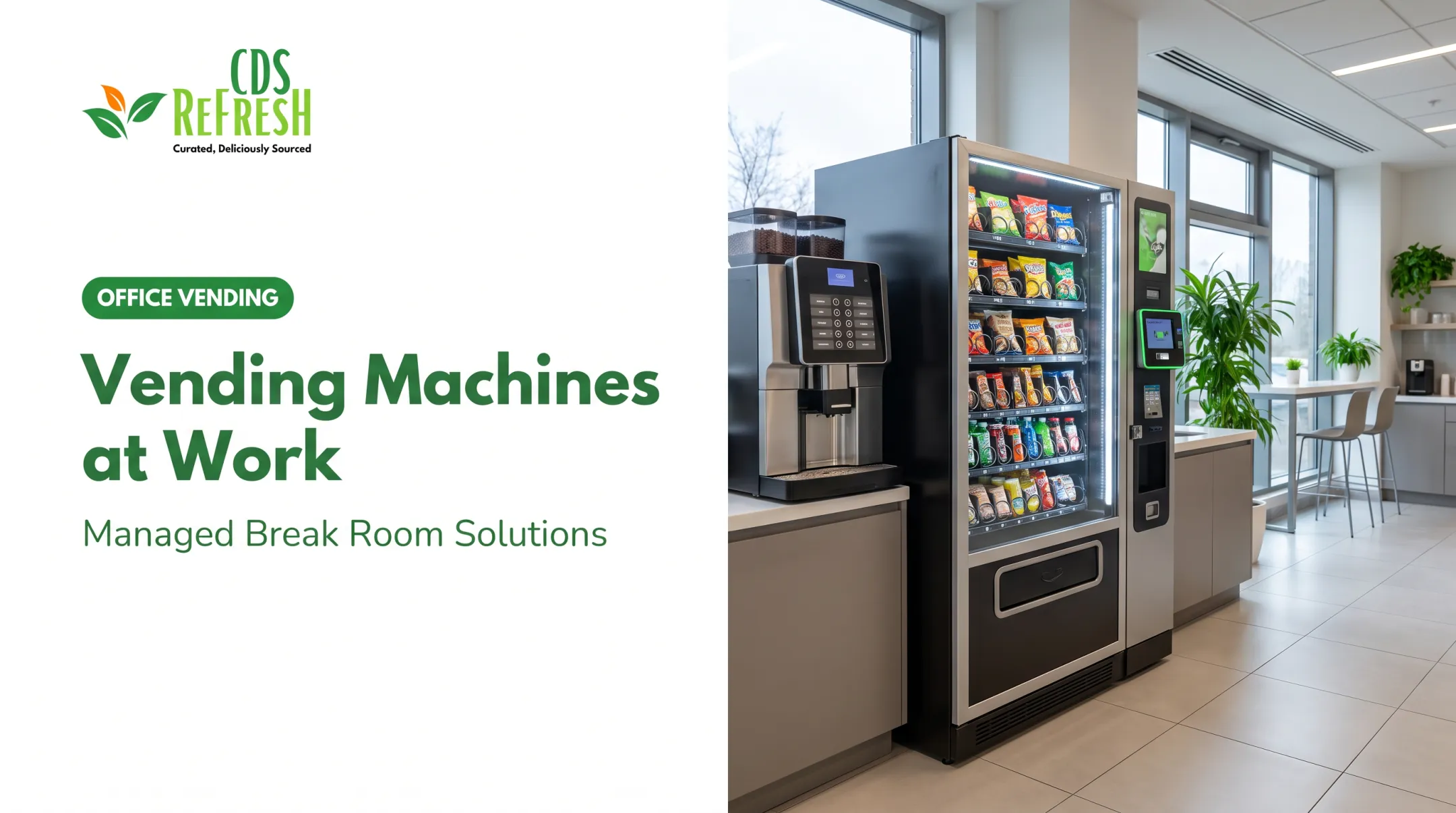
Traditional vending machines were built for one thing: shelf-stable packaged snacks. Chips, candy, soda. That's about it.
The problem? Employees don't just want chips anymore. 43% of workers want snacks that support energy and wellness goals, according to Sodexo's workplace snack research. Another 42% cite convenience, and 36% prioritize speed. A machine stocked entirely with sugar and preservatives can't check any of those boxes well.
Facility managers face their own headaches with legacy equipment:
- Stockouts on popular items with no way to know until someone complains
- Cash-only limitations that frustrate a workforce that barely carries cash anymore
- Maintenance delays when a machine breaks and the only fix is waiting on a technician's schedule
Modern refreshment technology addresses each of these gaps:
- Remote inventory monitoring flags low stock before it becomes a problem
- Cashless readers eliminate the "sorry, exact change only" issue entirely
- Providers with in-house repair capabilities can swap broken equipment instead of leaving an empty box in the break room for weeks

Top Vending Machine Alternatives for Offices and Facilities
Not every alternative fits every workplace. Here's what's actually available.
Micro-Markets
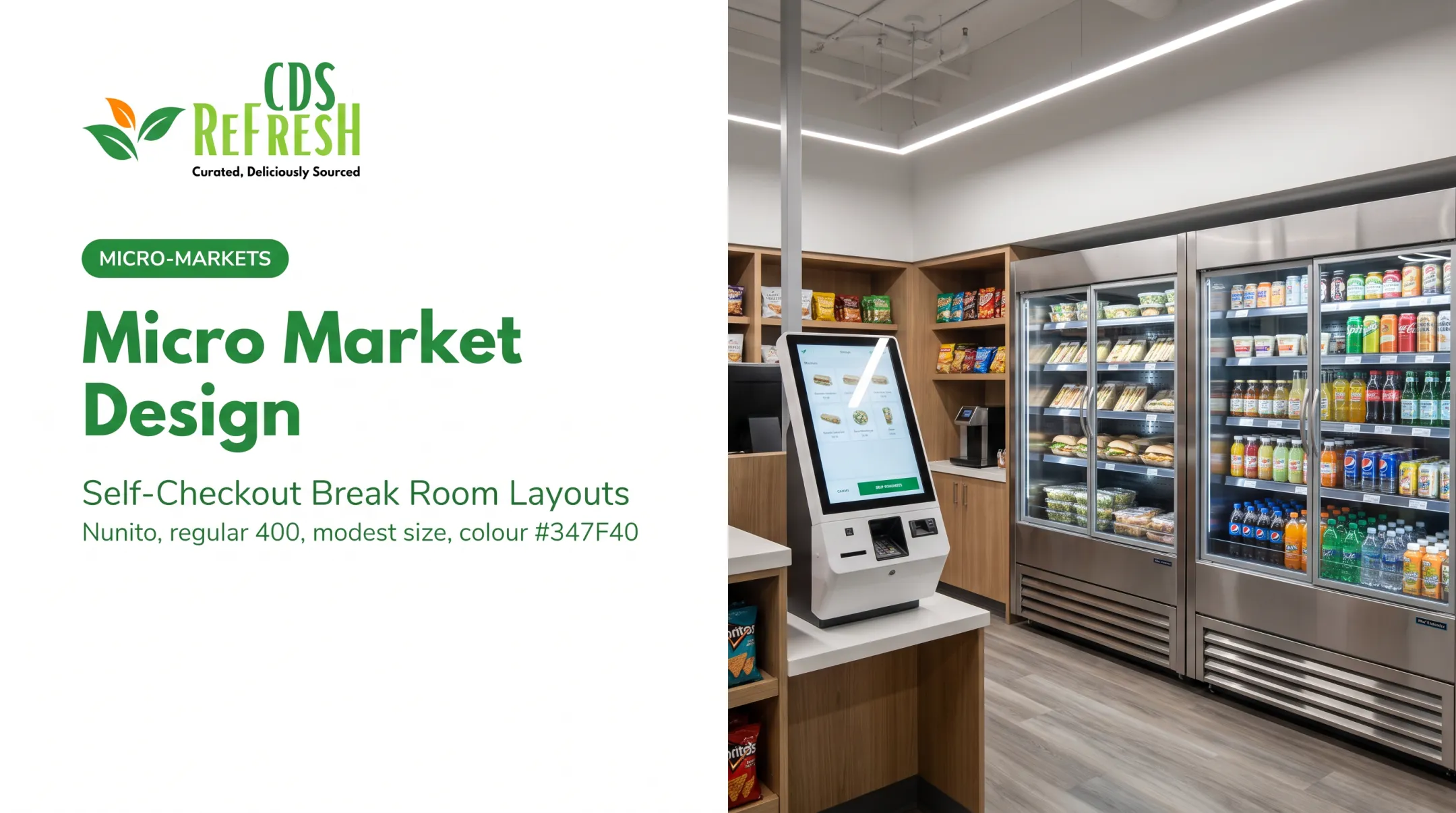
Think mini convenience store, minus the cashier. Micro-markets are unattended retail spaces with open shelving, coolers, fresh sandwiches, salads, and self-checkout kiosks, according to NAMA's convenience services data.
They're also the fastest-growing segment in the industry. Micro-market revenue jumped from just 2% of convenience-services revenue in 2014 to 20% by 2023, growing at 41% annually since 2020.

The catch: micro-markets need dedicated space, electrical access, and reliable internet. They work best where headcount justifies the footprint—though compact markets for under 100 employees are increasingly common.
Smart Coolers and Smart Cabinets
Smart coolers are compact, locked refrigeration units that stay sealed until a customer pays at a built-in touchscreen. Cantaloupe describes them as a genuine alternative to vending machines for spaces too small for a full market.
They're a good fit for:
- Satellite offices or break areas without room for a micro-market
- Secure, closed-loop environments (lower theft risk than public spaces)
- Businesses wanting fresh and frozen options without a big installation
Office Coffee and Pantry Services
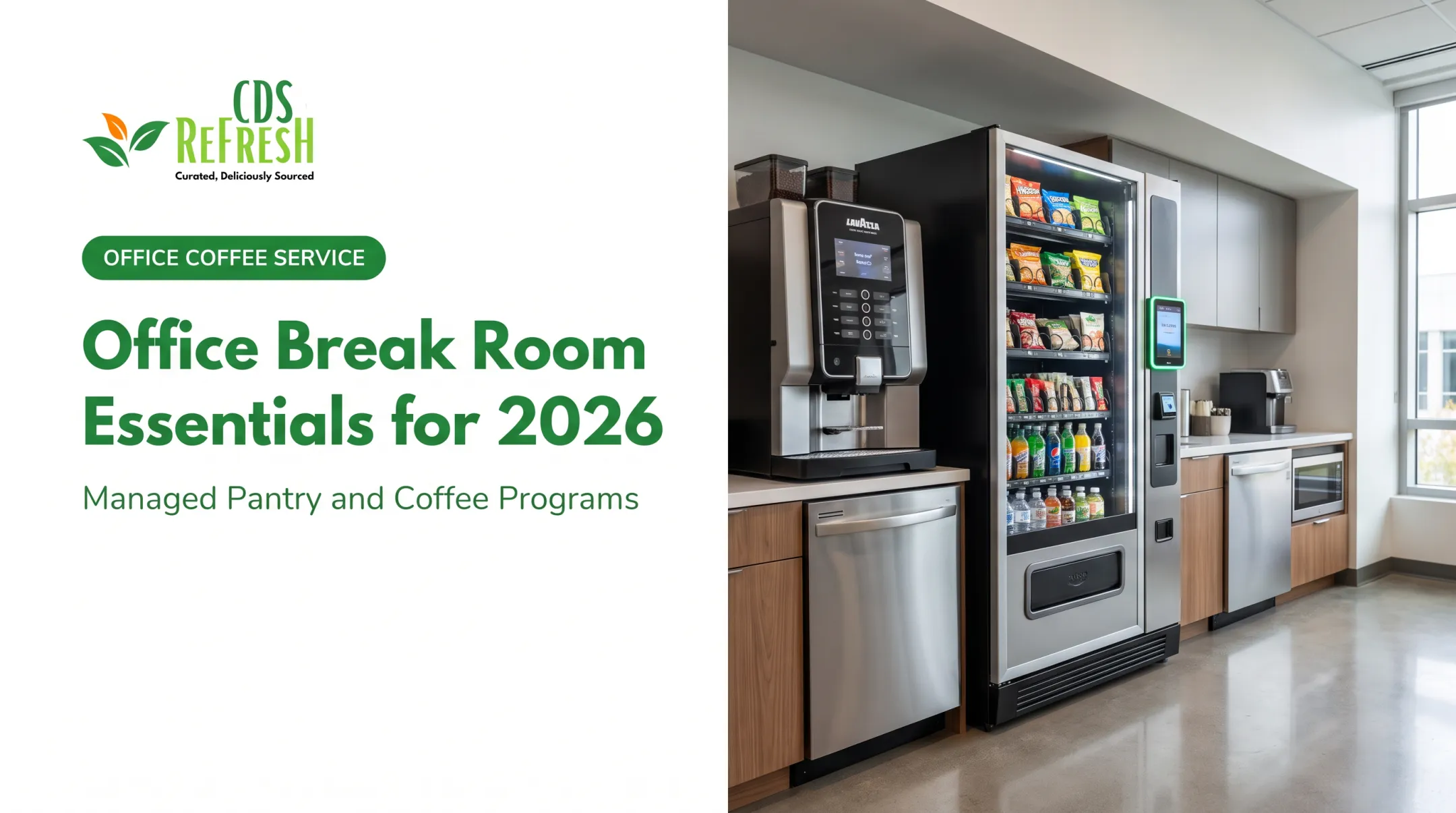
Coffee is often the first thing employees notice in a break room. Premium programs bring brands like Starbucks, Lavazza, and Peet's on site, with espresso and cappuccino machines that go well beyond a basic drip pot.
Add an employer-funded pantry for snacks and beverages, and you get a low-footprint "coffee corner" with outsized impact on daily satisfaction.
AI-Enabled Smart Technology
Real-time inventory tracking flags what's running low before shelves go empty. Cashless payment—including Apple Pay and Google Wallet—is now standard on modern equipment.
The data is clear: 96% of micro-market transactions and 100% of Smart Store transactions were cashless in 2024, per Cantaloupe's 2025 Micropayment Trends Report.

Snack Bars and Curated Break Rooms
Some workplaces skip a formal market and instead build a self-serve station combining healthy staples (fruit, nuts, protein bars) with a few indulgent options (cookies, chips). It's low-commitment and works well for smaller teams that don't need a full retail buildout.
A One-Stop Alternative Worth Considering
Here's where most businesses get stuck: picking just one option feels like a compromise. A micro-market may not fit a small satellite office, and a single coffee machine won't close the fresh-food gap.
CDS Refresh bundles these for DFW-area workplaces instead of selling them as separate boxes:
- Micro-markets for the main break room
- Smart coolers for satellite or space-constrained areas
- Coffee and pantry programs that tie the whole floor together
One provider handles install, stocking, and maintenance—so you're not juggling three vendors for one refreshment strategy.
How to Choose the Right Vending Alternative for Your Workplace
Picking the right fit comes down to five practical questions.
- How much space do you actually have? Micro-markets need dedicated square footage and internet access. Smart coolers and vending machines need far less room.
- How many employees will use it? Grand View Research puts the average micro-market at 100-150 employees, though smaller offices increasingly make markets work too.
- What's your theft/security risk? Closed-loop offices generally see lower shrinkage than public-facing locations. Cantaloupe reports typical micro-market shrinkage around 3-4%, which is usually lower than traditional vending in high-traffic or public-facing spots.
- What's the actual goal? Want broader variety? Choose a micro-market. Need fresh or cold access in a satellite space? A smart cooler fits. If culture and caffeine matter most, go with a coffee or pantry program.
- What cost structure fits your budget? Some providers use revenue-share models. Others lease equipment outright. Full-service providers with no purchasing restrictions—like CDS Refresh—build the plan around your preferences instead of a fixed catalog.

None of this needs to be guesswork. A site walkthrough with a break-room provider typically settles these questions in one visit.
Vending Machine Business Questions Answered
What is an alternative to a vending machine?
The three leading alternatives are micro-markets (self-checkout retail with fresh food), smart coolers (compact, locked refrigeration with cashless payment), and office coffee/pantry services. Most businesses combine two or more rather than choosing just one.
Are vending machines still profitable in 2026?
Yes, though margins are tightening. IBISWorld projects the U.S. vending machine operators industry at $7.9 billion in 2026, a modest decline from prior years. Meanwhile, the broader convenience-services category, including micro-markets, is projected to keep growing through 2028.
What is the most profitable type of vending machine?
Specialty, fresh, and refrigerated formats tend to command higher average transaction values than basic snack or soda machines. Cantaloupe's 2026 data shows average tickets of $4.49 for Smart Stores versus $2.01 for standard vending.
How many vending machines do you need to make $100k?
Revenue depends on foot traffic, location quality, and machine type far more than machine count. Model transaction volume, average ticket, product costs, and shrink rather than a generic per-machine benchmark.
Why Partner with a Full-Service Provider Like CDS Refresh
Single-machine vending puts a lot of pressure on one box to solve every break room problem. That rarely works out.
CDS Refresh has served the DFW Metroplex and Abilene since 1999, growing from a straightforward vending operation into a full-service refreshment partner offering micro-markets, smart coolers, office coffee, pantry programs, and event catering.
The company is verified as a veteran-owned business, founded by Navy veteran Carl Shepherd, and is minority-owned as well.
What sets CDS Refresh apart:
- One-on-one consulting during an initial site visit to assess space, employee preferences, and workplace culture before recommending anything
- A fully stocked warehouse and in-house machine shop, allowing equipment swaps while repairs happen behind the scenes instead of leaving an empty machine on-site
- No purchasing restrictions, meaning solutions get built around what your team actually wants rather than a fixed vendor catalog
For businesses across Arlington, Fort Worth, Plano, Dallas, and the surrounding DFW area, that means a break room strategy built around your workplace instead of retrofitted to fit a machine.
Frequently Asked Questions
Do I need an LLC to run a vending machine?
Not always required, but commonly recommended. The SBA notes that an LLC structure limits personal liability and affects taxes, making it a popular choice for vending operators.
What is the most profitable type of vending machine?
Specialty, fresh, and beverage-focused machines typically outperform basic snack vending on transaction value. Refrigerated and smart formats often command higher average tickets than traditional snack-only units.
Are vending machines still profitable in 2026?
Yes, vending remains a viable revenue stream, especially paired with cashless payment and remote inventory tools. Growth has slowed slightly, but diversified operators are offsetting that with micro-markets and smart coolers.
What is an alternative to a vending machine?
Micro-markets, smart coolers, and full-service pantry/coffee programs are the three leading alternatives. Many businesses combine these rather than relying on a single format.
How many vending machines do you need to make $100k?
This depends heavily on location traffic, machine type, and average transaction size rather than a fixed machine count. Foot traffic and product mix matter more than the number of units installed.